Tuesday, May 10, 2016

Ideal Gas and Dalton's Laws

The Ideal gas law is based on the Kinetic Theory of Gases, which states:

-Gases consist of small random particles(molecules) which are in continuous random motion

-The volume of the molecules persent is negligible compared to the total volume occupied by the gas

-Inter-molecular forces are negligible

-Pressure is due to gas molecules colliding with the walls of the container.

More on the Kinetic Theory of Gasses HERE. Its a little weird, but its good. It should be known that Real Gasses deviate from the Ideal Gas Behavior because:

-at low temperature the gas molecules have less kinetic energy(move around less) so they do attract each other

-at high pressure the gas molecules are forced closer together so that the volume of the gas molecules becomes significant compared to the volume the gas occupies


The Ideal Gas Laws is represented by the equation:
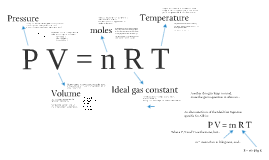
It should be noted that R is Ideal Gas Constant, and we will use the value .0821 L atm/mol k where K is the compound in question. It should also be noted that Pressure should be in atm. A video over this law HERE should be able to help you how to use it.


There is also a law called Dalton's Law. Now this one is very simple and is based on the idea of total pressure being the sum of the individual pressure of each gas when mixed in a container, to find the  partial pressure of each of the substances use this equation:

That is all, if you need a walk through use THIS video.
Thanks for watching

Thursday, May 5, 2016

Avagadro's Law and The Combined Gas Law

So today we will discuss Avagadro's Law, which is a law that involves moles, so the first thing you need to know is that at STP, which is 1 atm and 0 degrees Celsius, there are 22.4 Liters of gas in one mole. Our next law will go over when the gas is not at STP. Avagadro's Law says that if there is a constant temperature and pressure, it does not have to be at STP, the volume is directly proportional to the number of moles. If you don't understand then go HERE. The equation also can look like this
Where V=Volume, n=amount in moles

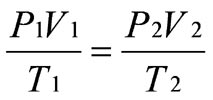
There is also the combined gas law. It is really just an equation that shows the relationship between pressure, volume, and temperature; however it only applies when the amount of gas is constant. The equation looks something like this:
If you want to see someone work through a problem and how and when to use it, look HERE.


And that is all, thanks for reading.

Tuesday, May 3, 2016

Kelvin and Charles

So, today we learned of two things, one of the is the unit called Kelvin. Kelvin is a unit of measure on an absolute scale, the temperature has a direct effect on the behavior of the gas. To convert to Kelvin, you take the degrees Celsius and add 273.15. This value should always, be greater than zero, as 0 K is equivalent to absolute zero, which has yet to be discovered by humanity.

Now that you know what Kelvin is, you can actually use the second thing that we learned, Charles' Law. Charles' Law states that if the Pressure and amount of a gas are help constant then as temperature increases the volume of the container must increase, and vice versa, as well as must decrease if the other decreases. If you don't understand go HERE to see a video on it.

The equation looks a little like this:
And the temperature when using this equation must be in Kelvin, which is why we learned it.

I think that's all. Peace.

Monday, May 2, 2016

Gassy

So we started gas laws today, and they are not that bad. Mostly its math, and we have a lot of rules, but it doesn't matter, as I am sort of good a math. Anyway the first thins to know is the basic principles of a gas,being that:

they expand spontaneously to fill their container,
they are highly compressible,
they form homogeneous mixtures,
and they have molecules relatively far apart from one another and exert little influence on each other.

For more information refer to THIS video.

One of the key parts of a gas, and Gas Laws, is pressure, which we will define as the frequency of the gas particles contacting the side of its container. The more common units of measuring pressure of a gas are as follows:
However we are not likely to use Bar. It is also good to know that 1 atm. is equivalent to air pressure at sea level.

Now that that's out of the way,it would be good for you to learn Boyle's Law. It is the simplest and easy to learn. So Boyle's Law states that if you have a gas, and keep the temperature of that gas, as well as the amount of that gas constant, then the pressure of that gas multiplied by the volume of that gas will be equal to the changed pressure of that gas multiplied by the changed volume of that gas. If that didn't make sense, go HERE to learn more. The equation looks a little like this:
And the relationship, in a graph, looks like this.
In short, the volume of a substance is in a inverse relationship with the pressure if, and only if, the temperature and amount are held constant.


Thanks for watching.