Tuesday, May 10, 2016

Ideal Gas and Dalton's Laws

The Ideal gas law is based on the Kinetic Theory of Gases, which states:

-Gases consist of small random particles(molecules) which are in continuous random motion

-The volume of the molecules persent is negligible compared to the total volume occupied by the gas

-Inter-molecular forces are negligible

-Pressure is due to gas molecules colliding with the walls of the container.

More on the Kinetic Theory of Gasses HERE. Its a little weird, but its good. It should be known that Real Gasses deviate from the Ideal Gas Behavior because:

-at low temperature the gas molecules have less kinetic energy(move around less) so they do attract each other

-at high pressure the gas molecules are forced closer together so that the volume of the gas molecules becomes significant compared to the volume the gas occupies


The Ideal Gas Laws is represented by the equation:
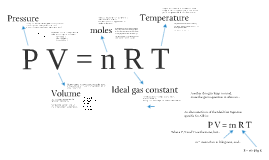
It should be noted that R is Ideal Gas Constant, and we will use the value .0821 L atm/mol k where K is the compound in question. It should also be noted that Pressure should be in atm. A video over this law HERE should be able to help you how to use it.


There is also a law called Dalton's Law. Now this one is very simple and is based on the idea of total pressure being the sum of the individual pressure of each gas when mixed in a container, to find the  partial pressure of each of the substances use this equation:

That is all, if you need a walk through use THIS video.
Thanks for watching

Thursday, May 5, 2016

Avagadro's Law and The Combined Gas Law

So today we will discuss Avagadro's Law, which is a law that involves moles, so the first thing you need to know is that at STP, which is 1 atm and 0 degrees Celsius, there are 22.4 Liters of gas in one mole. Our next law will go over when the gas is not at STP. Avagadro's Law says that if there is a constant temperature and pressure, it does not have to be at STP, the volume is directly proportional to the number of moles. If you don't understand then go HERE. The equation also can look like this
Where V=Volume, n=amount in moles

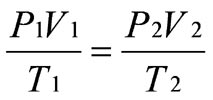
There is also the combined gas law. It is really just an equation that shows the relationship between pressure, volume, and temperature; however it only applies when the amount of gas is constant. The equation looks something like this:
If you want to see someone work through a problem and how and when to use it, look HERE.


And that is all, thanks for reading.

Tuesday, May 3, 2016

Kelvin and Charles

So, today we learned of two things, one of the is the unit called Kelvin. Kelvin is a unit of measure on an absolute scale, the temperature has a direct effect on the behavior of the gas. To convert to Kelvin, you take the degrees Celsius and add 273.15. This value should always, be greater than zero, as 0 K is equivalent to absolute zero, which has yet to be discovered by humanity.

Now that you know what Kelvin is, you can actually use the second thing that we learned, Charles' Law. Charles' Law states that if the Pressure and amount of a gas are help constant then as temperature increases the volume of the container must increase, and vice versa, as well as must decrease if the other decreases. If you don't understand go HERE to see a video on it.

The equation looks a little like this:
And the temperature when using this equation must be in Kelvin, which is why we learned it.

I think that's all. Peace.

Monday, May 2, 2016

Gassy

So we started gas laws today, and they are not that bad. Mostly its math, and we have a lot of rules, but it doesn't matter, as I am sort of good a math. Anyway the first thins to know is the basic principles of a gas,being that:

they expand spontaneously to fill their container,
they are highly compressible,
they form homogeneous mixtures,
and they have molecules relatively far apart from one another and exert little influence on each other.

For more information refer to THIS video.

One of the key parts of a gas, and Gas Laws, is pressure, which we will define as the frequency of the gas particles contacting the side of its container. The more common units of measuring pressure of a gas are as follows:
However we are not likely to use Bar. It is also good to know that 1 atm. is equivalent to air pressure at sea level.

Now that that's out of the way,it would be good for you to learn Boyle's Law. It is the simplest and easy to learn. So Boyle's Law states that if you have a gas, and keep the temperature of that gas, as well as the amount of that gas constant, then the pressure of that gas multiplied by the volume of that gas will be equal to the changed pressure of that gas multiplied by the changed volume of that gas. If that didn't make sense, go HERE to learn more. The equation looks a little like this:
And the relationship, in a graph, looks like this.
In short, the volume of a substance is in a inverse relationship with the pressure if, and only if, the temperature and amount are held constant.


Thanks for watching.

Thursday, April 21, 2016

Molecular Forces

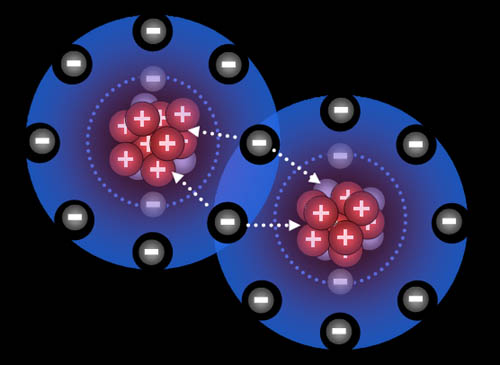
So today we are going over the 5 different Inter-molecular forces, we won't touch Intra-molecular as those are part of atomic structure, and you should already know that but if you don't go HERE, and watch everything. Ok, your back. Now go HERE and watch the top four videos. They should help alot. and then you will understand this:
A wonderful chart to help figure out which force is which, memorize it, live it, love it. 


Finally, HERE is a video on phase diagrams and stuff. Well that's all folks.

Monday, April 18, 2016

Energy, Temperature, and Heat

So reacting chemicals have more than just reactants becoming products, there is also changes in the heat of a compound, with it either being absorbed or released, as it is necessary for breaking bonds. The two types of reactions, Exo and Endo are gone over HERE, as it is sort of hard to tell which is which sometimes, but this image should help:
Heat movement is really the transfer of energy, and as such there are two types of energy, Kinetic and Potential. Kinetic energy is the energy of motion, KE = 1/2mv^2. Potential is the energy stored. The difference is showed by the image here:
And HERE is a video on it, with a quiz.

The last thing you need to know is MCAT.
is actually a an equation that looks a little like:
And HERE someone goes over how to do it for you.

And that is all

Thursday, April 14, 2016

Race Day

So we synthesized some BioDiesel for our class, and we had some fun. We used these Put-Put engines:
To make boats like this:

They work by using a vacuum to suck water into the boiler, heat it up, then it shoots out the other tub, creating a vacuum, and so on. This propels the boat forward, ta da. To see how to make one go HERE. To see a race of these things look HERE.
I didn't win by the way.

Wednesday, April 6, 2016

BioDiesel

BioDiesel, for those of you who didn't watch the video, is a vegetable oil product, that functions like petroleum Diesel, It is combustible under pressure, and is made from a long carbon chain, an oxygen double bond, and CH3. it looks like this:
To make it, do what THESE people do,  
In Short, BioDiesel is a synthetic version of Petroleum Diesel with low emissions and produced from resources we already have excess of. HERE is a video going through and comparing the two types of fuel

Tuesday, April 5, 2016

CLICK THIS LINK

Everybody go HERE. Thank you, it is part of a contest to help raise awareness of BioDiesel. BioDiesel is a green fuel source that lowers greenhouse gasses its GREEN.

In Short be green, and use BioDiesel. Yeah.
While your at it go to THIS site to learn more.

Tuesday, March 15, 2016

Resonance

Resonance is a concept that is involved with the structure of an atom that has a bond that can go anywhere, such as in CO3, where any of the Oxygen Atoms can have the double bond, When this happens you probably are going to draw out the different options, and then draw the hybrid model, which the entire process looks like this looks like this:
HERE Crash Course goes over briefly what resonance is, and gives an example, and delicious analogy, about them. However it should be noted that in this class we will use dashed lines to represent the P(PI) bonds that divide out averagely. In short, resonance occurs when the Lewis Model offers multiple correct models, and the real structure has an average of the extra.

Monday, March 14, 2016

Lewis Structures and Bonding Models

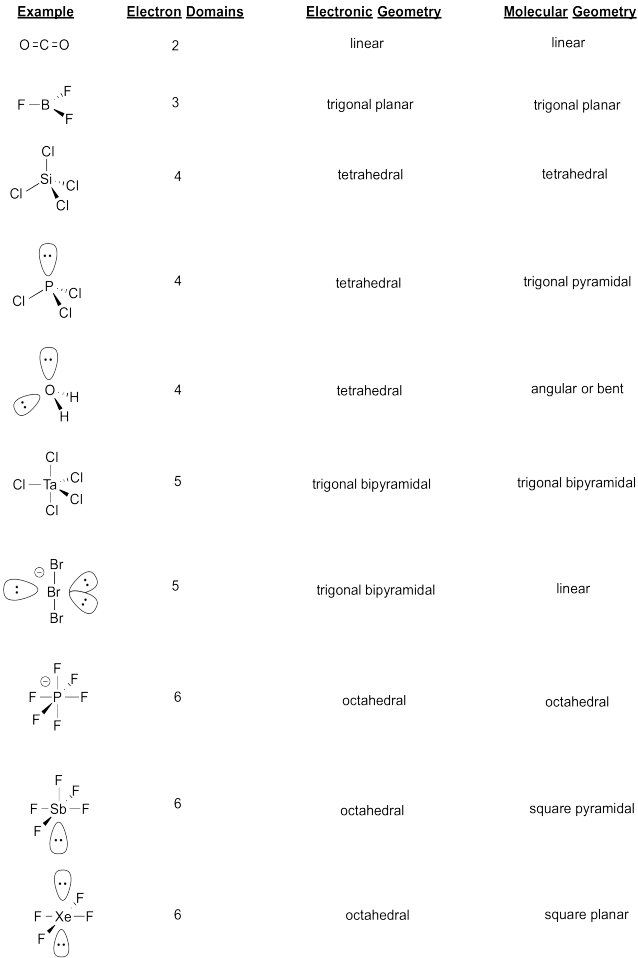
In THIS video, Crash Course goes over the different types of organizing the structure that occur in chemical bonds. It is important to note that he says not all models are correct. In our class however that is not important, We must purely focus on the structure offered by the Lewis Model. HERE is another video going over the Lewis Structure. You must also understand the Geometry that he mentions when discussing tetrahedral and linear shapes. You only have to know Tetrahedral, Trigonal Planar, Linear, and Octohedral. There is also shapes that will result in polar structures, these are the Bent and Trigonal Pyramidal. In short if the central atom has a single electron or a single lone pair of electrons, its polar. HERE is a video going over how lone pairs affect shape and polarity. And here is a image showing different types of geometric shapes and the corresponding Lewis Structure:
Have a good day.

Sunday, March 13, 2016

Concepts

So in the last unit, there were some pretty confusing concepts, but one of the simplest was the idea of core and valence electrons, valence being the one that are directly involved with forming bonds, and core bonds being the bonds that are on the inside, and have an identical structure to the noble gas that last came before it. When bonding a chemical is trying to have a stable outer electron shell with 8 electrons, either shared or not, in it. It should be noted that ionic bonds are not part of this unit, because they are "simple" in comparison. This is because of the difference shown here:
In the bond on the left there is a sharing of electrons, while on the right there is an ionic bond.Think of it like the electron is a business, they both need to have eight employees, but there are 14 in all, so if two employees work at both businesses there is no problem at all. In an ionic bond one of the businesses would just be underemployed. THIS video will go over the two in more depth. This picture shows the electron exchange of fluorine:
In short this unit is over the sharing of electrons between atoms, resulting in complex chemicals such as water and acids. Crash Course goes over bonds HERE.

Thursday, March 10, 2016

Trends

Periodic trends generally go along a diagonal line from the bottom left to the top right, as Helium is the most stable element, it rarely reacts. Periodic trends apply to ionization energy to electronegativity. In short, the smallest, least reactive, and most likely elements to draw electrons toward itself when in an bod are at the top, and on the right. while they get larger and more reactive, more likely to give electrons and with less density near the bottom. Its really simple, imagine a diagonal line across the periodic table, and all trends should stick to it.

Wednesday, March 9, 2016

Quantum Stuff

Okay so this is really a simple concept, I am just going to be talking on how to classify a single electron in a atom, and then take this weird set of numbers to figure out what atom it is. It a four digit code where the first digit means the period that the atom is in. The next means the sub level, which is the orbital type, 0=S, 1=P, 2=D, and 3=F. Next is the Magnetic Quantum Number, which depending on the orbital, could be only a single digit, or seven different ones, If you make a dash for each electron grouping in the atom, and then label them from the starting at the middle with 0, and going in either direction a positive or negative 1, then again till you have filled all the dashes, then use the rules of electron placement to fill them in until you have used all the electrons that the configuration gave you, then you say which number it is. Finally is the spin, if there is two electrons in the last dash you filled it is a -1/2 spin, and +1/2 spin if there is only one. Ta-Da, that's how you do it. HERE is a video going more in depth on them to help

Tuesday, March 8, 2016

Orbitals

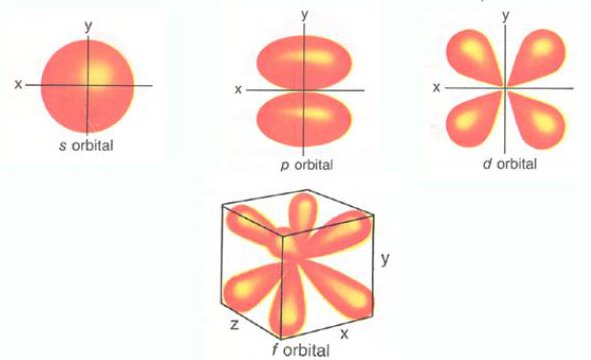
So orbitals are sorta important, so I will first start with the different types. There is an S orbitals which is spherical in shape with a single orbital of 2 electrons. P orbitals which is dumbbell in shape with 3 orbitals and 6 electrons. D orbitals are like two crossing dumbbells with 5 orbitals and 10 electrons. Finally there is F orbitals which are with 7 different orbitals and 14 electrons. This all looks like this:
The orbitals function in a weird way, to name an atoms electron configuration you first name the electron configuration of the period before it then you name the different orbitals before the one you are finishing at, for example phosphorus is 1s2 2s2 2p6 3s2 3p3. which shows you that is has the periods 1 and 2 as its core electrons, with a 3s2 orbital and a 3p3 orbital as its valence electrons. HERE Crash Course goes over orbitals, and HERE is a good website going over atoms in general. Also, here is the what you would label each atom when writing its configuration:
This should give enough for the next lesson, quantum stuff.

Wednesday, March 2, 2016

Electrons

So I post this realizing that I have said nothing about the fundamental part of this unit, the electron. Since this unit is over ELECTRONic structure it makes sense to know what I talking(typing) about. As you probably know the electron is part of an atom that provides a negative electric charge to the atom to counter the positive charge of the proton creating 'balance' in the electrical charge. However the important part is that electrons are the things that actually change when a bond happens, the electrons get shared between the atoms and connect them, this happens because atoms like to have complete orbitals. An orbital consists of two atoms, with opposite spin on each other that balance each other. Spin looks like this: and is important because of how electron behave magnetically shown HERE
As the period number goes up the more orbitals there are. Each period has a independent maximum number of orbitals, with the highest max consisting of all four orbital types, simply named SPDF or, Smart People Dropped First semester. On my previous blog post(shameless self advertising)HERE I linked a crash course video on electrons I recommend you watch it. I my next post I will go more in depth on orbitals and naming the individual ground state of an atom. Have a wonderful day.

Tuesday, March 1, 2016

Wavelength Energy and Frequency

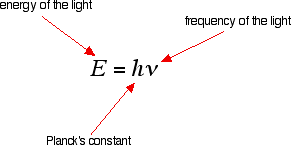
The entire lesson revolves around electrons, so if you don't know electrons yet come HERE, and the correlation between the wavelength of light and energy contained per photon. The basis of calculating the frequency of the light, which can be done by taking the speed of light divided by the wave length your trying to find the energy of, this results in the frequency of the light inversely per second. This also happens to be the Hertz(Hz) of the wavelength. If you multiply Hz by 6.63 x 10e-34, which is known as Plank's Constant you will get the energy of the light per photon, to find energy per mole you would multiply by Avogadro's number. This picture lays out the equation for light. 
This generally sums up how to find energy from wavelength and vice versa. Have a wonderful day.

Monday, February 29, 2016

Light Is The Key

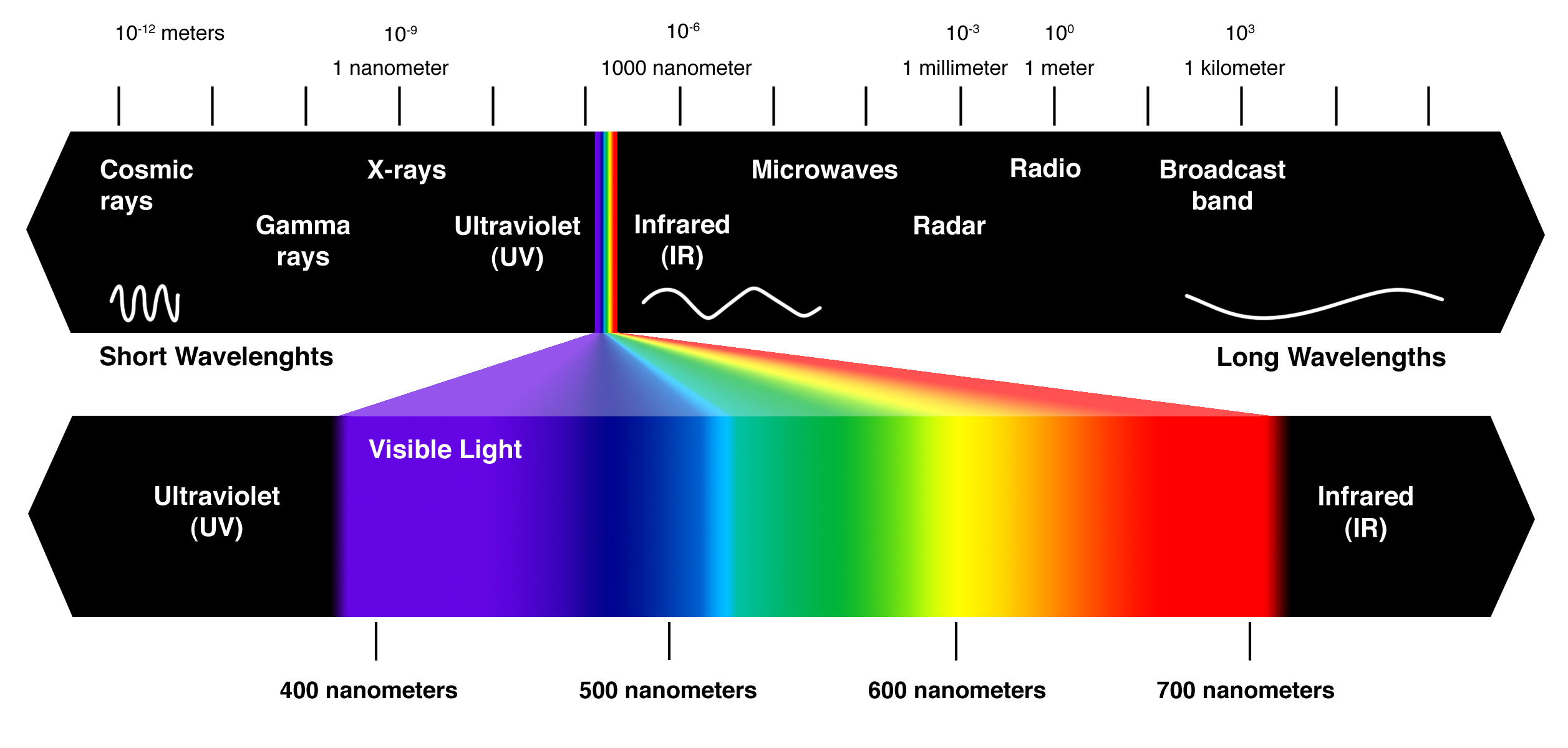
In Short this unit focuses on energy, the movement of light, and how radiation carries energy at different frequencies of energy make up the spectrum of light here:
Light is only visible when the distance between the arcs of the waves are between 400 and 750 nanometers, which is what we will mostly work with in lab, especially because we only have access to school level equipment, and because we are still new to this and need something easy. HERE, a bit of knowledge is dropped on you about radiation and this spectrum above you and yeah, that's about it. Join us next post on how to do math about light with your host M Hart.

Friday, February 12, 2016

We Did A Thing

Do we did the same thing we did for our last lab, but instead we had to figure out what the chemical was, and what its mass was. After some serious science (not actually that serious) we deduced that the chemical was in fact acetylsalicylic acid, which I did in fact have to look up in order to spell. We did this by standardizing a base to find its Molarity, then we used the same base to find the titration of the acid. We then used some spec-ops level mathematics(not really too advanced) and found the mass of the chemical, from then we did some more math and reasoning, plus a little help from friends, and found out that it was in fact acetylsalicylic acid, which was promptly confirmed in a class wide announcement. So yeah, I did a thing.

Monday, February 8, 2016

Playing with Acids(and Base)mk 1

So I got to play with Base and Acid in our last lab. It was fun. We took a base solution of NaOH and titrated it into a solution of Vinegar. We then calculated the molarity of the vinegar using Stoichiometry. Not to hard, and it is extremely(exactly) like the video I linked to last blog. We ended up being pretty darn close, so I guess I did good, peace.

Friday, February 5, 2016

Titration

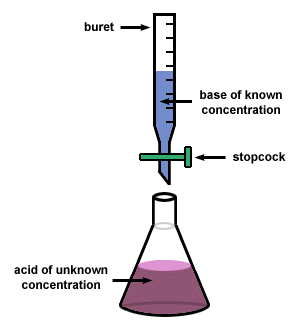
Titration is a simple process used to try and find information on acids or bases. We can use a buret to add a solution of acid or base with known Molarity to reach the equilibrium point by adding the Acid or Base into a solution of either an Acid or Base and a indicator to tell when equilibrium has been reached. You can then use that to find whatever data on the unknown you need. The set up when titrating looks like this:
And to see how to actually titrate look HERE

Tuesday, February 2, 2016

pH and pOH

Now imma do a taboo and use something I already used in this unit, but I gotta, go HERE to see more on pH and pOH, again, as a refresher, but after you read everything. And since I like to use lots of videos, HERE'S another guy explaining it.

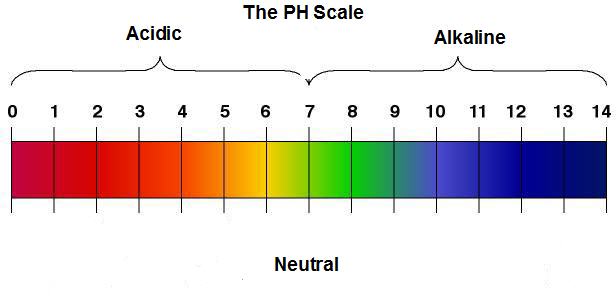
But anyway, pH is the measure of power of H+ in the mixture. It is on a scale of 1 to 14, normally, with 7 being a perfect neutral, and is pure water. pOH is the same, but has the power of OH- in the mixture. Oh, and both are inverse, so a low pH is a high Acid power, and a low pOH is a high Base power. With these powers being ten times more acidic or basic than the next: ex. a pH of 2 is 100 times more acidic than a pH of 4.
To get a visual of how the scale works, put your gaze here:

To find these magical number you take the - Logarithm base 10 to the moles of H+(or OH- depending on what your trying to find) to get the pH, and to derive the pOH from pH, or vice versa, you take 14 and subtract the one you have. Poof, you have what you were looking for.

Friday, January 29, 2016

Acid/Base Reactions-Salt and Water(Salty Water?)

First things first, salt does not mean table salt, a salt is the compound formed from the anion of an acid, and the cation of the base.

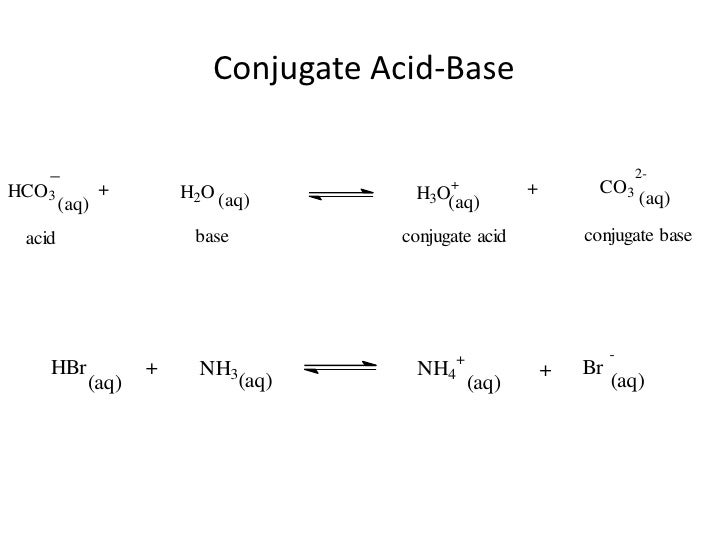
Now that that's cleared up a Acid Base Reaction looks like this:
\
Which shows the two types of reactions, however we are only going over Arrhenius Acid/Base reactions, ones that form a salt and water every time.

There are three types of salts that can be produced, neutral, acidic, and basic.
A Neutral Salt is produced when a Strong Acid reacts with a Strong Base, or a Weak Acid reacts with a Weak Base.
A Acidic Salt is formed when a Strong Acid reacts with a Weak Base
and A Basic Salt is formed when a Weak Acid reacts with a Strong Base

Acid Base reactions happen in water, and in water, the H+ ion does some strange things
Which are gone over HERE by Crash Course.
And he basically goes over everything, Haben Sie einen schönen Tag.

Wednesday, January 27, 2016

Acids vs. Bases

There are two parts to this unit. Acids and Bases. There are two general definitions of both Acids and Bases, one that defines them by the ions that make them up, and another that defines them by the ions that are exchanged in the reaction.

An Acid can be defined by as the chemical that either contains an H+ ion, or it is the chemical in the reaction that donates a proton. A Base is defined as a chemical that either contain OH-, or it is the chemical that receives a proton. A picture to help:
There are two types Acids and Bases, Strong and Weak. Which I went over HERE.
Crash Course also went over it HERE

Thursday, January 14, 2016

Reaction in Solution

Lets get this straight. If had trouble with Stochiometry, this will either be very helpful for getting you better at that, or you'll hate it, because that is essentially what your doing. If you need a refresher on Stoich, go HERE(shameless self-advertising) and do some reading, then come back, I'll wait.... Ok your back, so now that you know what your doing it is really the same thing, but to get moles you use molarity and volume, not molar mass. Use the 5 STEP PLAN
1) Balance equation
2) Calculate moles of substance
3) Determine the Limiting Reagent
4) Calculate moles of product
5) Convert to Units
Its that easy, here is picture to show how easy it is:
And a video for those auditory learners out there.
I think thats all, peace off.

Sunday, January 10, 2016

Dilutions

M1 x V1 = M2 x V2
This equation is the most important from this topic. It will help you figure out how to work with taking a solution and diluting it. The M stands for Molarity(moles per liter) and V for volume. Obviously the 1 and 2 stand for the original values the result values. HERE Crash Course goes over dilutions and Molarity in a video you've probably already seen.

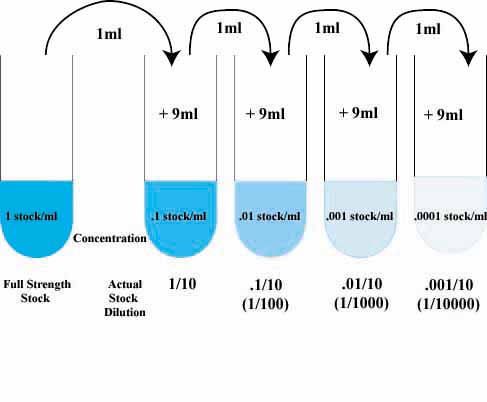
Dilutions are a solution that's been "watered down" or had extra solution of a different molarity added. When "watering down" a solution to a certain molarity, you use a serial dilution, which means you take an aliqout (amount of solvent removed to make new solution) of equal amounts, and equal amounts of water. They look like this:
HERE is a video explaining serial dilution as it involves microbiology.
That should be all you need.

Friday, January 8, 2016

Aqueous Solutions

Most Ionic Compounds will dissolve in water, and when they dissolve they disassociate into their respective cations and anions. The number of Ions that are in a Ionic Bind dictates how many Ions are disassociated, for example NaCl disassociates into two Ions but MgCl2 disassociates into three ions.
So before I start to explain a unit about something, I should probably go over the general thing, which in this case is Aqueous Solutions. An Aqueous Solution is a mixture that takes place in water, with the solute being dissolved into water, which is the solvent. Examples include Chlorine dissolving in a pool.

However Polar Substances will disassociate based on their attraction to water, while most insoluble materials are non-polar.

If a molecule contains -OH then the shorter the C-H chain is the more likely it is to dissolve in water 
Crash Course helped me understand this better HERE
Oh,and understanding polarity might help, so HERE
And a visual of Polar vs Nonpolar: