HERE Crash Course goes over briefly what resonance is, and gives an example, and delicious analogy, about them. However it should be noted that in this class we will use dashed lines to represent the P(PI) bonds that divide out averagely. In short, resonance occurs when the Lewis Model offers multiple correct models, and the real structure has an average of the extra.
Tuesday, March 15, 2016
Resonance
Resonance is a concept that is involved with the structure of an atom that has a bond that can go anywhere, such as in CO3, where any of the Oxygen Atoms can have the double bond, When this happens you probably are going to draw out the different options, and then draw the hybrid model, which the entire process looks like this looks like this:
Monday, March 14, 2016
Lewis Structures and Bonding Models
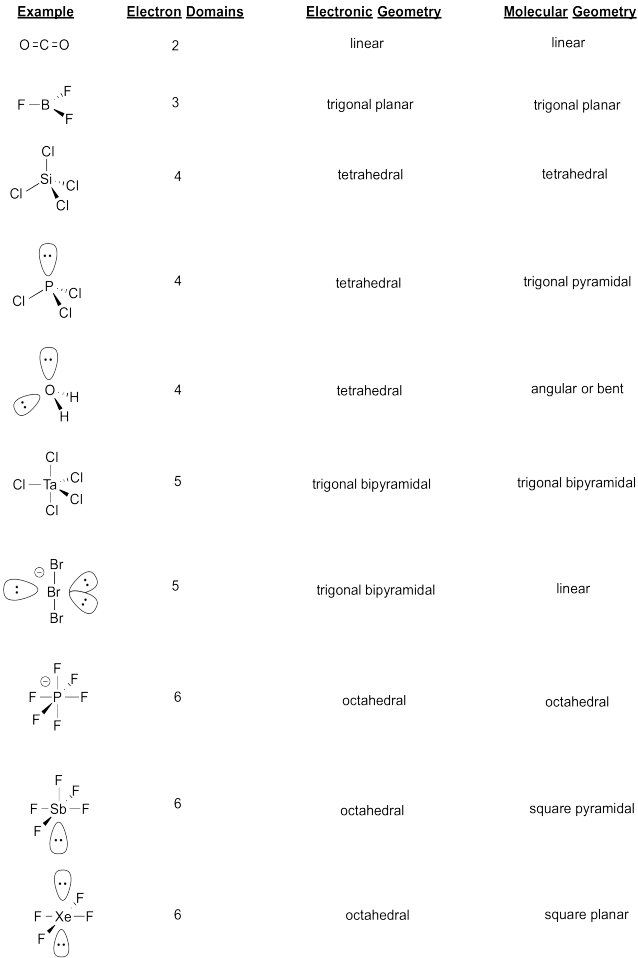
In THIS video, Crash Course goes over the different types of organizing the structure that occur in chemical bonds. It is important to note that he says not all models are correct. In our class however that is not important, We must purely focus on the structure offered by the Lewis Model. HERE is another video going over the Lewis Structure. You must also understand the Geometry that he mentions when discussing tetrahedral and linear shapes. You only have to know Tetrahedral, Trigonal Planar, Linear, and Octohedral. There is also shapes that will result in polar structures, these are the Bent and Trigonal Pyramidal. In short if the central atom has a single electron or a single lone pair of electrons, its polar. HERE is a video going over how lone pairs affect shape and polarity. And here is a image showing different types of geometric shapes and the corresponding Lewis Structure:
Have a good day.
Sunday, March 13, 2016
Concepts
So in the last unit, there were some pretty confusing concepts, but one of the simplest was the idea of core and valence electrons, valence being the one that are directly involved with forming bonds, and core bonds being the bonds that are on the inside, and have an identical structure to the noble gas that last came before it. When bonding a chemical is trying to have a stable outer electron shell with 8 electrons, either shared or not, in it. It should be noted that ionic bonds are not part of this unit, because they are "simple" in comparison. This is because of the difference shown here:
In the bond on the left there is a sharing of electrons, while on the right there is an ionic bond.Think of it like the electron is a business, they both need to have eight employees, but there are 14 in all, so if two employees work at both businesses there is no problem at all. In an ionic bond one of the businesses would just be underemployed. THIS video will go over the two in more depth. This picture shows the electron exchange of fluorine:
In short this unit is over the sharing of electrons between atoms, resulting in complex chemicals such as water and acids. Crash Course goes over bonds HERE.
Thursday, March 10, 2016
Trends
Periodic trends generally go along a diagonal line from the bottom left to the top right, as Helium is the most stable element, it rarely reacts. Periodic trends apply to ionization energy to electronegativity. In short, the smallest, least reactive, and most likely elements to draw electrons toward itself when in an bod are at the top, and on the right. while they get larger and more reactive, more likely to give electrons and with less density near the bottom. Its really simple, imagine a diagonal line across the periodic table, and all trends should stick to it.
Wednesday, March 9, 2016
Quantum Stuff
Okay so this is really a simple concept, I am just going to be talking on how to classify a single electron in a atom, and then take this weird set of numbers to figure out what atom it is. It a four digit code where the first digit means the period that the atom is in. The next means the sub level, which is the orbital type, 0=S, 1=P, 2=D, and 3=F. Next is the Magnetic Quantum Number, which depending on the orbital, could be only a single digit, or seven different ones, If you make a dash for each electron grouping in the atom, and then label them from the starting at the middle with 0, and going in either direction a positive or negative 1, then again till you have filled all the dashes, then use the rules of electron placement to fill them in until you have used all the electrons that the configuration gave you, then you say which number it is. Finally is the spin, if there is two electrons in the last dash you filled it is a -1/2 spin, and +1/2 spin if there is only one. Ta-Da, that's how you do it. HERE is a video going more in depth on them to help
Tuesday, March 8, 2016
Orbitals
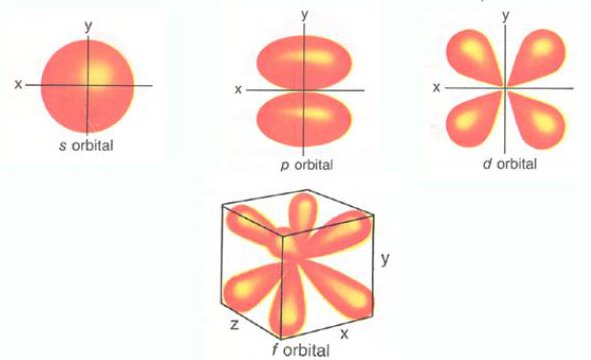
So orbitals are sorta important, so I will first start with the different types. There is an S orbitals which is spherical in shape with a single orbital of 2 electrons. P orbitals which is dumbbell in shape with 3 orbitals and 6 electrons. D orbitals are like two crossing dumbbells with 5 orbitals and 10 electrons. Finally there is F orbitals which are with 7 different orbitals and 14 electrons. This all looks like this:
The orbitals function in a weird way, to name an atoms electron configuration you first name the electron configuration of the period before it then you name the different orbitals before the one you are finishing at, for example phosphorus is 1s2 2s2 2p6 3s2 3p3. which shows you that is has the periods 1 and 2 as its core electrons, with a 3s2 orbital and a 3p3 orbital as its valence electrons. HERE Crash Course goes over orbitals, and HERE is a good website going over atoms in general. Also, here is the what you would label each atom when writing its configuration:
This should give enough for the next lesson, quantum stuff.
Wednesday, March 2, 2016
Electrons
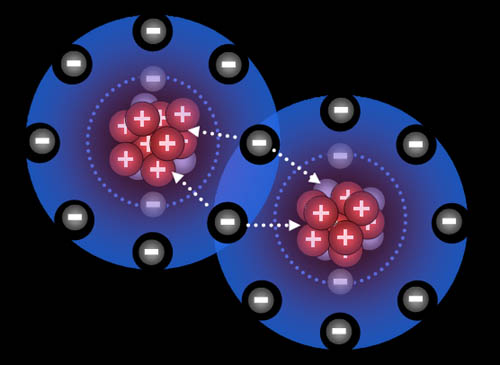
So I post this realizing that I have said nothing about the fundamental part of this unit, the electron. Since this unit is over ELECTRONic structure it makes sense to know what I talking(typing) about. As you probably know the electron is part of an atom that provides a negative electric charge to the atom to counter the positive charge of the proton creating 'balance' in the electrical charge. However the important part is that electrons are the things that actually change when a bond happens, the electrons get shared between the atoms and connect them, this happens because atoms like to have complete orbitals. An orbital consists of two atoms, with opposite spin on each other that balance each other. Spin looks like this: and is important because of how electron behave magnetically shown HERE
As the period number goes up the more orbitals there are. Each period has a independent maximum number of orbitals, with the highest max consisting of all four orbital types, simply named SPDF or, Smart People Dropped First semester. On my previous blog post(shameless self advertising)HERE I linked a crash course video on electrons I recommend you watch it. I my next post I will go more in depth on orbitals and naming the individual ground state of an atom. Have a wonderful day.
Tuesday, March 1, 2016
Wavelength Energy and Frequency
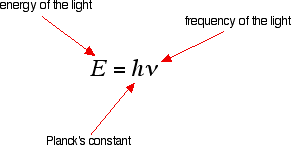
The entire lesson revolves around electrons, so if you don't know electrons yet come HERE, and the correlation between the wavelength of light and energy contained per photon. The basis of calculating the frequency of the light, which can be done by taking the speed of light divided by the wave length your trying to find the energy of, this results in the frequency of the light inversely per second. This also happens to be the Hertz(Hz) of the wavelength. If you multiply Hz by 6.63 x 10e-34, which is known as Plank's Constant you will get the energy of the light per photon, to find energy per mole you would multiply by Avogadro's number. This picture lays out the equation for light.
This generally sums up how to find energy from wavelength and vice versa. Have a wonderful day.
Subscribe to:
Posts (Atom)