Monday, November 30, 2015

RedOx

Oxidation is part of RedOx, which stands for Reduction Oxidation Reaction. In it one compound reacts with a pure substance, and if oxidation can occur, a reaction will occur. Oxidation occurs due to these rules:
In these reactions, only a single chemical replaces another, either cations switch, or anions switch. You can figure if the cations will switch using the Reactivity Series for Metals:
Where a metal has to be more reactive than the one it is trying to replace to switch with it. The Reactivity Series for Non-Metals are on Group 7 on the Periodic Table. An important Acronym for RedOx is OILRIG, which means Oxidation Is Loss, Reduction Is Gain. 

Crash course explains RedOx much better HERE

Sunday, November 29, 2015

Strong vs. Weak Acids

After my last post I realized that I neglected to state the differences between Strong and Weak Acids. All that really matters is the difference between them when it comes to disassociating Acids for Acids Base Reactions. The key to telling them apart is that all Strong Acids have enough Oxygen to outnumber the Hydrogen by at least 2. However, HCl, HBr, and HI are all Strong Acids as well. HERE, Crash Course goes over the basics of pH, and Strong and Weak Acids.

Wednesday, November 25, 2015

Acid Base Reactions

Acid Base Reactions are reactions that involve an acid and a aqueous compound forming water and an aqueous salt. A salt is a cation from the base, and an anion from an acid. The hydrogen from the acid is switched with the cation of the compound, which must have a hydroxide poly-atomic ion in it You would then disassociate and turn into a Complete Ionic Equation, then into a Net Ionic Equation. A picture of a balanced Acid Base Reaction probably helps understand:
HERE, Crash Course goes over Acid Base Reactions as well.

Tuesday, November 24, 2015

Compustion

Combustion is a reaction that only occurs when O2 is present. Three things to know about Combustion is:
1) There has to be O2.
2) Combustion of a Hydrocarbon always produces H2O & CO2.
3) It is RedOx reaction.
Some basic Combustion equations are:
HERE is a link to a video that shows how to balance Combustion equations.

Wednesday, November 18, 2015

Double Replacement Reactions

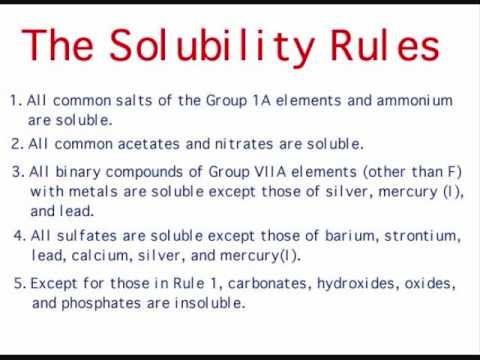
A reaction that takes place when two Aqueous Ionic Compounds switch cations and result in an Aqueous Ionic Compound and a Solid. However, not all occurrences of the switch are reactions, some will not produce solids and both compounds remain aqueous. You can tell if there is a solid formed using the solubility rules:
If no solid is formed, you're done, finished, no reaction, but if there is you must also balance the reaction equation. Then you must disassociate the equations, or break apart the chemical compounds into their respective ions to get the Complete Ionic Equation. After this you cancel chemicals that are on both side resulting in the Net Ionic Equation.

If you want to see how its done, go HERE.

Balancing Reactions

We learned how to balance chemical reaction equation. For this to happen, the chemical must follow the Law of Conservation of Mass, which says you can't make something out of nothing, and vice versa. To do this, you must make it so that each side of the equation has the same number of each chemical, as shown below:
To see it done, just go to THIS video.
It is a relatively simple idea, but can be hard, and is needed for the entire area of Chemical Reactions.

Tuesday, November 17, 2015

Test Day

You ever feel like your teacher is out to watch the world burn. What I mean is that my extremely intelligent friend walks out from the class before and says, "that was really hard." This is a guy who is 150% better than me at this class. I was worried, and rightfully so. When the kid who is normally one of the first done isn't finished before the bell, it's either A) too long; or B) REALLY HARD. It was the latter. I mean we all looked like this:
And that was the ones who didn't look like they'd been hit with a 2x4.
So I went to the Internet to learn more so I can bring my grade up and found: from Crash Course a playlist of all their Chemistry videos. So ya, I give up, Peace Off

Second Missed Lab

So I, being the "genius" I am, didn't learn from my first failed lab attempt and study up more, and, as the title suggests, failed the second Pre-Lab, the next day. aren't I smart. Luckily I figured out my mistake and learned more on Hydrated Compounds. I finally learned, and got to do more fun* math. *Not actually the fun part of math, that's Calculus.

However I found a really good graphic for Hydrated Crystals:
And then looked for more people to teach me, and find them I did. I found a SITE to help 

Lab That I Didn't Do

So I missed a lab on Hydrated compounds, but don't worry. I did the math part.
It's right here:

The lab was also directly related to the notes I missed, but it's most definitely my fault I didn't get to do it, which is a bad on me. So I looked to us video of someone doing it, and it's right HERE

Chemical Reactions

We started a unit, with no Pre-Test, it was weird. We took notes instead, on Chemical Reactions

Friday, November 6, 2015

Notes that I'm not there for.

So I missed a day of school, on the one day we didn't have book notes.
Luckily my awesome lab partner helped me and gave me notes.
And I understood nothing.
Luckily THIS guy helped understand. 
As well as a Chemistry webpage to help. YAY